
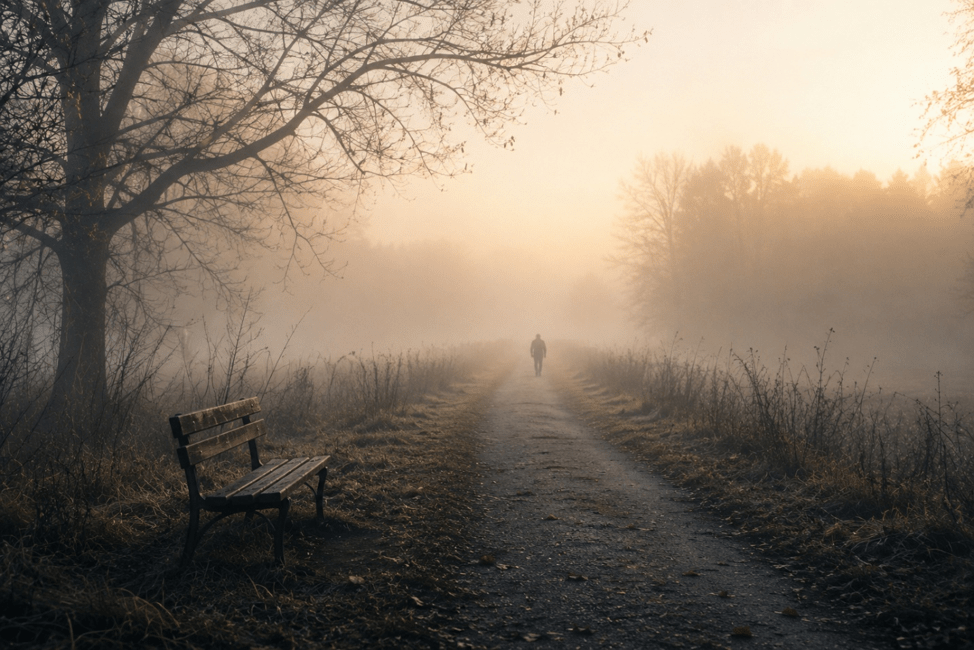
We tend to think of memory as a collection of things we have managed to keep: names, faces, dates, places, and moments that somehow survived the passage of time. We often measure the richness of our lives by what we can still remember, treating every forgotten detail as a small loss. Yet, we rarely pause to appreciate the architecture of the other side of memory. We rarely stop to examine the profound, quiet grace of everything we have forgotten.
Where do the thousands of ordinary conversations go once they vanish without a trace? What happens to the exact geometry of the streets we walked hundreds of times in our youth, but could no longer sketch on a napkin? We routinely forget the names of people who once seemed utterly essential to our survival, and we lose track of the specific anxieties that occupied entire seasons of our lives. If we look closely at our own history, we must admit that most of what we have lived has already been surrendered to time.
We often treat forgetting as a failure, a loss, or even a betrayal of the mind. But perhaps oblivion is something else entirely. Perhaps forgetting is one of the mind’s quiet ways of helping us move forward. The truth is, we could not carry it all. It would be impossible to take a single step forward if every detail of every day remained equally vivid forever: every old slight, every passing glance of a stranger, every piece of distant noise bleeding through an open window. The mind, in its quiet wisdom, selects. It drops the trivial baggage so the traveler can keep moving, releasing pieces of the past even when we do not understand its criteria.
Faces inevitably fade into the mist of years, yet the specific texture of the emotions they awakened remains rooted in our chests. We forget the names of towns and sanctuaries, but we still remember the exact quality of the peace—or the visceral discomfort—they made us feel. Time acts as a solvent, softening the sharp edges of historical events until only a raw impression survives. It functions like an old photograph left too long in the sharp glare of the sun: its physical shapes are nearly erased, but the quality of its light remains entirely visible. What is remarkable about the human condition is that we frequently remember the lasting effect of a blow long after we have forgotten its source.
This is because the body carries its own memory, an ancient shorthand that does not depend on language, archives, or conscious thought. Perhaps that is why we still avoid certain places without remembering exactly what happened there. We carry the feeling even when the story itself has faded. It explains why a heavy melancholy lingers in the afternoon even when we can no longer trace its origin, and why we sometimes trust a stranger immediately, unable to identify the long-ago moment that first taught us how to feel safe. The mind may forget the cause, but the body often remembers the effect.
The past, then, does not live only in the archives we can consciously retrieve. It lives in intuition, in automatic habits, and in the invisible traces left behind by things that no longer have a name. We are shaped not only by the milestones we celebrate and remember, but also by the ghosts we have allowed to fall away. We are not merely the sum of our memories; we are also the beautifully sculpted result of everything time chose to erase. Forgetting is not a form of loss, but a way of traveling lighter—an architectural necessity to make room for the present. In that quiet, empty space built from both history and oblivion, we continue, day by day, becoming who we are.
Originally published in Spanish as “Lo que olvidamos también nos construye” on Un Blog para el Alma as part of the Memory series.
Read the original Spanish version here: https://unblogparaelalma.blogspot.com/2026/06/serie-la-memoria-lo-que-olvidamos-tambien-nos-construye.htm
Adapted and translated into English by the author.
© 2026 W. E. Ticas. All rights reserved.

